
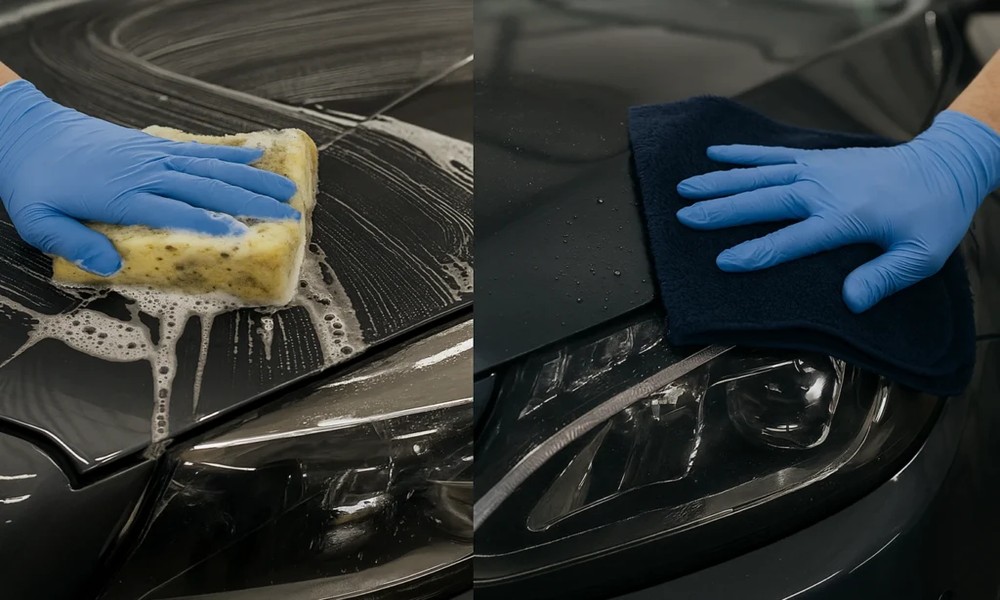

Most paint damage doesn’t happen in a single dramatic moment. There’s rarely a scratch you can point to and say, “that’s where it started.” Instead, the finish dulls gradually – a little haze here, a faint swirl there – until one sunny afternoon you notice the reflection isn’t as sharp as it used to be.
The frustrating part is that a lot of this wear comes from routine car care, not neglect. People who wash their vehicles every weekend often do more harm than the ones who let it sit dusty in the driveway. Good intentions, wrong technique.
Below are seven of the most common habits that quietly chip away at a vehicle’s clear coat, why each one matters, and what to do differently. None of this requires professional equipment – just a clearer sense of how automotive paint actually behaves.
1. Washing in Direct Sunlight
It feels productive to wash the car on a bright, warm day. The problem is heat.
When the body panels are hot, water and soap evaporate before you can rinse them away. That leaves behind dissolved minerals – the same calcium and magnesium found in ordinary tap water – baked onto the surface as water spots. On a dark finish, those rings can become surprisingly stubborn.
Heat also forces you to work faster than the products were designed for, which usually means more pressure and less lubrication. Wash in the early morning or late afternoon instead, ideally in the shade, and keep the panels cool and wet from start to finish.
2. Reaching for Dish Soap and Household Cleaners
This one is everywhere, and it’s worth unpacking.
Dish detergent is engineered to cut grease. That’s exactly why it’s the wrong tool for paint: it strips away the wax, sealant, or coating protecting the surface along with the dirt. Do it once and you’ve simply removed your protection early. Do it every wash and the clear coat spends most of its life exposed to UV light, road film, and acidic fallout with nothing standing between it and the elements.
A dedicated pH-balanced car shampoo cleans effectively without dissolving the protective layer underneath. The same caution applies to all-purpose household sprays on trim, glass, and wheels – many contain solvents or strong alkalines that discolor rubber and plastic over time.
3. Using One Bucket and a Tired Wash Mitt
Here’s the mechanism behind most of the fine scratching you see on older cars.
Dirt is abrasive. When you dunk a dirty mitt back into the same bucket of soapy water, you’re loading it with grit and then dragging that grit across the paint on the next pass. Under bright light, the result shows up as swirl marks – those spider-web rings that appear to rotate around a light source.
The fix is the two-bucket method: one bucket of clean wash solution, one of plain water to rinse the mitt between panels. A grit guard at the bottom of each bucket traps debris so it stays out of circulation. Work top to bottom, since the lower body panels and rocker areas hold the most contamination, and you don’t want that grime migrating up onto cleaner surfaces.
4. Treating Automatic Brush Tunnels as Routine
The convenience is real, and an occasional pass through a touchless or well-maintained wash won’t ruin anything.
The issue is the older-style tunnels with stiff, spinning bristles. Those brushes scrub hundreds of vehicles a day, and they don’t reset between cars. Grit, sand, and trapped debris from the truck ahead of you get pressed into your finish, which is how marring and spider-webbing accumulate over months of “harmless” weekly washes.
If you rely on a commercial wash, lean toward touchless systems, and consider a careful hand wash for anything you want to keep looking sharp long-term.
5. Drying the Wrong Way
Drying gets overlooked because it seems like the easy part. It isn’t.
Letting a car air-dry guarantees water spots, since every droplet leaves its mineral residue behind as it evaporates. On the other end, an old terry-cloth bath towel is coarse enough to leave its own light scratches, especially if any dust settled on the panels during the wash.
Reach for a clean, plush microfiber drying towel and blot or gently pull it across the surface rather than scrubbing. A quick spray of detailing lubricant adds slip and lowers the friction even further. Small change, noticeable difference over time.
6. Letting Contaminants Sit Too Long
Some of the worst paint damage comes from things people assume will rinse off eventually.
Bird droppings are the classic example. They’re genuinely acidic – typically a pH somewhere around 3 to 4.5 – and as they dry in the sun, that acid eats into the clear coat and can leave a permanent etched outline that no amount of washing removes. Tree sap, insect remains, and industrial fallout work the same way: the longer they bond to the surface, the deeper the mark.
Speed matters more than technique here. Flood the spot with a lubricated wash solution, let it soften for a couple of minutes without scrubbing, then lift it away with a clean microfiber.
Beyond the obvious deposits, paint also collects bonded contamination you can feel but not always see – a gritty texture when you run a clean hand across a freshly washed panel. A clay bar or clay mitt removes that embedded grime and resets the surface, which is why decontamination is a standard first step before any polishing or coating.
7. Skipping a Protective Layer Entirely
If there’s one habit that quietly does the most damage, it’s leaving the paint bare.
Wax, synthetic sealants, and ceramic coatings all serve the same basic purpose: they act as a sacrificial barrier. Contaminants, UV exposure, and mild chemicals hit that layer first instead of the clear coat itself. Without it, the finish oxidizes faster, colors fade sooner, and water sheets across the panels instead of beading off.
You don’t have to commit to an expensive coating to benefit. Even a basic spray sealant applied a few times a year dramatically slows the wear. The protection you choose matters far less than simply having something on the surface at all.
Knowing When to Bring in a Professional
There’s a point where the smartest move is handing the job to someone who does it full-time.
Heavy oxidation, deep swirling, or etching that’s already set in usually calls for machine polishing and paint correction – work that’s easy to make worse without the right experience. A thorough exterior detailing and paint correction service can restore clarity that no amount of careful washing will recover on its own, then leave a fresh protective layer behind so the finish starts holding up again.
When you’re vetting a shop, looking for technicians certified through the International Detailing Association is a reasonable filter, since it signals a commitment to established standards rather than guesswork.
For routine maintenance, mobile services have made consistency far more realistic than it used to be. Providers like Cargo Detailing come to the driveway, which removes most of the excuses that lead to skipped washes and neglected protection in the first place.
The Takeaway
Healthy paint isn’t about doing more – it’s about doing a few things correctly and consistently. Wash when the panels are cool, use products meant for the surface, keep grit out of the equation, dry with care, deal with contaminants quickly, and always leave a protective layer in place.
Get those fundamentals right and the finish holds its depth for years. The shine you’re trying to protect was never about expensive products. It comes down to avoiding the small, repeatable mistakes that most of us make without ever realizing it.